Religious Significance | Types of Flags | Hoisting
Prayer Flags | Inauspicious Days
Calendar | Flag Hoisting in Tibetan Culture | Rituals
involved while hoisting Flags | Layout of Tibetan Prayer Flags | Symbols
on Prayer Flags | Eight Auspicious Symbols | Eight
Glorious Offerings | The Seven Jewels of Royal Power | Other
Signs and Symbols on the Flags | Handling and Flying Prayer
Flags | Traditional Tibetan Prayer Flags | Birthday
&
New Year Prayer Flags
History of Prayer Flags 
The custom of flag hoisting dates back to several thousand years. It was
found within the nomadic (drogpa) communities and they used to hoist flags to
ensure good fortune, luck and prosperity.
But originally the flag hoisting was related with war. The banners (Ru-dar)
found in ancient literature were military flags. Ru- refers to gathering of
people while moving from one place to another and in archaic sense this assembly
is referred to a kind of army. Dar- means flags. During wars, armies used to
take flags for protection and as a symbol of pride.
Religious Significance 
The flags gained religious significance in Bon tradition and gradually the
design of the flags changed. According to Bon teachings, when mantras wrapped in
five colored silk and placed high in the mountains, it would provide good
fortune and bring prosperity to the person who sees it. The five color flags
should be in this order.
Hoisting of Dra-lha (a deity who helps in overcoming obstacles and enemies)
promotes welfare of all sentient beings and flourishes dharma.
There are some quotes in ancient text to show the protective power of the prayer
flags...
A great battle ensued between the Gods and Asuras (demi gods) because of a
wish-fulfilling tree. The gods
were enjoying the fruits of the tree, which grew
in the valley of Mt. Meru, and Asuras claimed that the fruits belonged to them
only as the tree was rooted in their area and thus the war began. Lord Indra
plead Vajrapani for help and he told Indra to invite brothers of Dra-lha and
said they would help. Nine weapons and nine deities then appeared from the great
ocean and by worshiping them Indra achieved victory over the Asura.
Another such story to show the protective power of the flag is of Lord Indra seeking Lord
Buddha's help after a bad defeat by demi gods (asuras). Lord
Buddha was in the 33rd realm of the gods, seated on a flat stone. Indra came and
prostrated before Him. Indra explained that he and other gods of the 33rd realm
had suffered defeat at the hands of Vemchitra (king of demi gods) and asked
Buddha what he should do.
Lord Buddha advised him to memorize Gyaltsen tsemo mantras and told him
that Buddha himself had recited them and preached to many decibels. He added
that since the time he learned the mantras he could not remember even a moment
when he felt fear or terror. So, He told Indra to carry this mantra into the
battle and thus victory was achieved.
The knowledge of the Gyaltsen Tsemo flag was carried into Tibet around 800
C.E and the actual flags were introduced no later then 1040 C. E.
|
Types of Flags
There are several types of Tibetan flags but they all generally come under
2 broad categories.
1. Dar-ding - These are long strings of flags hoisted horizontally
between trees or pillars with five colored flags kept in a sequence. First comes
the Yellow, followed by Green, Red, White and Blue.
2. Darchen - These are narrow flags flown vertically on a pole and can
be hoisted outside houses.
|
When prayer flags can be hoisted
Prayer
flags are hoisted on auspicious days like Sunday, Monday, Wednesday, Thursday,
Friday and when stars are in an auspicious arrangement according to the Tibetan
almanac.
It is believed that if flags are hoisted on inauspicious days, it might have
adverse effects.
"Sadak Badhen Trapo" is an inauspicious day according to the Tibetan almanac.
Thus while hoisting of flag you have to see that the date isn't inauspicious. It
is generally believed that its better to hoist the flag during the first 15 days
of the (Lunar calendar). As a norm Friday’s are considered most auspicious of
all days traditionally, its a very good day for many events not going into
specific astrological chart of one individually.
Traditionally there are prayers recited or
read during the hoisting of new prayer flags. Here are two of the most
commonly used ones. Raising the Wind Horse and Riwo Sangchod please click on
the prayers for a copy of the prayers.
|
DAY’S NOT TO
HANG NEW TIBETAN PRAYER FLAGS

TIBETAN YEAR 2132 WOOD BIRD YEAR
Inauspicious days according to Tibetan Lunar Calendar
FROM THE TIBETAN MEDICAL & ASTRO INSTITUTE OF HH THE DALAI
LAMA
|
MONTH |
1 |
2 |
3 |
4 |
5 |
6 |
6 (2nd) |
7 |
8 |
9 |
10 |
11 |
12 |
|
Day 1-15 |
10 |
7 |
4 |
1 |
10 |
7 |
7 |
4 |
1 |
10 |
|
4 |
1 |
|
Day 15-25 |
22 |
19 |
16 |
13 |
22 |
19 |
19 |
|
13 |
22 |
19 |
16 |
13 |
|
Day 25 to the end of the month |
| |
28 |
28 |
| | |
28 |
25 |
| |
28 |
25 |
Inauspicious Days for hoisting
Prayer Flags 
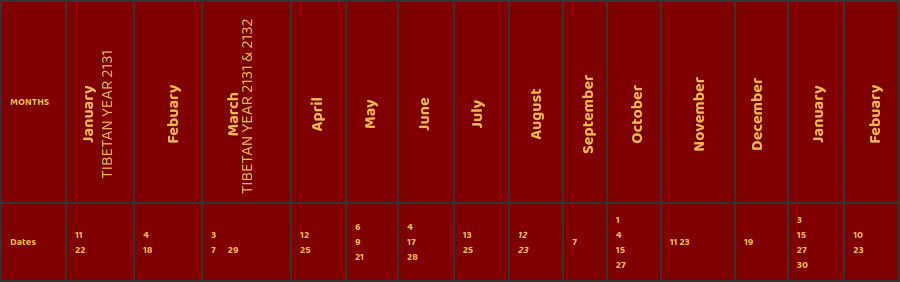
DATES TRANSLATED TO INTERNATIONAL CALENDAR
Year 2005-2006 FIRST DAY OF
TIBETAN YEAR IS 9TH OF FEB 2005
|
MONTHS |
 |
 |
 |
 |
 |
 |
 |
 |
 |
 |
 |
 |
 |
 |
|
Dates |
11
22 |
4
18 |
3
7 29 |
12
25 |
6
9
21 |
4
17
28 |
13
25 |
12
23 |
7 |
1
4
15
27 |
11
23 |
19 |
3
15
27 30 |
10
23 |
Kindly note that if you have already
hoisted your Tibetan Prayer flags earlier, you need not take them down on these
days because they are inauspicious. It is believed to be inauspicious to hang
new ones on these days. Let the ones already up and flying send their prayers in
the breeze and wind and only if you plan to hang new ones should you be
concerned about these dates. It is about 92.5% auspicious days in a year.
Your chances of being a good day are much, much better than a bad day. LHA GYAL
LOO!
|
Flag Hoisting in Tibetan Culture

Flags are flown on important occasions like 3rd day of Tibetan New Year "Losar",
Marriages and official functions. People belonging to all classes and background
fly them. Prayer flags are also hoisted at times of illness and while traveling
to avert misfortunes.
In some parts of Tibet, during wedding ceremonies, every one gathers on top
of the roof to hoist flags and in the ritual the bride touches the prayer flags
which signifies that she now has become a member of the new family. The next day
she returns back home and performs the same ritual of flag hoisting which
separates from her original family.
Originally, flag ceremonies were intended to provide benefit in this life,
but as they gradually became more imbued with religious meanings, they came to
be associated with benefits in future lives and achievement of spiritual
enlightenment as opposed to material success.
|
Rituals involved while hoisting flags

The prayer flag hoisting is accompanied by various and the most important
of them being the Incense offering.
It is still unclear whether the custom of incense offering originated from
India or it was already prevalent in Tibet. As per Indian texts 2 references on
this practice can be found. It is mentioned in the Guhyasamaja Tantra that one
should know about the three kinds of fragrance. The other reference is to be
found in the story of Bhadri of Magadha, which tells of how she invited the
Buddha to her housed and made offerings of smoke to him from the roof.
According to other scholars the practice of incense offering in Tibet
started at the time when Tonpa Sherap the founder of Bon Tradition first came to
Tibet from Zhanf Zhung. Others believe that incense offering practice started in
the 8th century when Padmasambhava came to Tibet and built Samye Monastery.
The Incense offering should be done in the morning on a clean and elevated
outdoor site, free of insects, either on a hill or the top of a house. The
incense should be burned in a large urn-shaped burner (sang-khun), along with
the essence Tsampa, butter, sugar, and medicinal plants.
Then actual hoisting of prayer flag is done. They are either hung
horizontally across trees or vertically on poles depending on the type of the
flag. The Dar-Chens is flown vertically while Dar-Dings are flown horizontally.
The flag hoisters then meditate on the four immeasurable wishes - love,
compassion, joy and equanimity and visualize themselves as deities.
The offering ends with the practitioners asking the deities to forgive them
for any mistakes in the performance of the ritual, such as improperly or
incompletely reciting the words of the text. The deities are then asked to
return to their abodes and auspicious verses are recited.
Offering Traditional Tibetan Scarves on Prayers Flags

Khata is an informal term
and Jael-dhar is the formal term, for traditional Tibetan
offering scarf. Khatas are made of
cotton, silk or other materials. They look more like a long scarf and have
auspicious symbols or mantras inscribed or woven
into the fabric. It represents the sincerity of ones offering, with no negative
thoughts or motives in mind. They come predominantly in shades of white or ivory,
due to the purity of the color but you will also find them in Blue, Red,
Green
and Yellow/Gold Yellow. It is a part of Tibetan way of life from birth to
death and between. It is also used as a sign of recognition of one’s love or
respect for another. The offering of Khata is probably one of the most well
known customs of Tibetan culture. Something that one could call a Tibetan
bouquet, that is very reusable and one specific Khata may travel the world over.
It
is also flown and put on Prayer Flags before one hangs them as a sign of your
prayers being sincere and pure, also as an offering to the Gods for swift
accomplishment of prayers and wishes.
To
the left is picture of an old Khata that one may not see in use these days,
commonly used during the 1960’s to 1980’s.
TSAMPA
& THE CUSTOM OF THROWING IN THE AIR:
Tsampa is used
as another major ingredient in any ritual. TSAMPA is a Tibetan word meaning
roasted barley or any other grain flour, used in a number of auspicious
occasions and it is also the staple food of Tibet. It is commonly ate in its
flour form or kneaded with a mixture of either tea or water, and added with
butter, sugar or spices as one may choose. Served with a dish of meat or
vegetable to ones choice. It tastes great, water kneaded and a pinch of hot
spicy sauce as a side dip. It is used in various ritual and offerings, it is a
common part of monastic life to have them regularly, in meals and also as
offering in various ways. Tsampa is very wholesome and filling and it is
definitely an acquired taste. Try some and you may want more if you taste buds
like it.
The flag
hoisters take a hand full or these days a pinch of Tsampa each and throw it in
the air, you can substitute this with any flour, if Tsampa is not available,
this ends the hoisting ceremony of Prayer Flags and then people gathered will
rejoice and celebrate, the event and day.
Only oral
accounts of the throwing of Tsampa in the air is available as no written records
can be traced. It is believed to have been prevalent before the advent of
Buddhism in Tibet. It has been a part of Tibet customs and traditions ever since
and continues to this day. The natives used to offer their crops and harvests to
the gods as offering. With Bon being the main religion then, the ritual custom of
throwing Tsampa in the air became more widespread and established and continued
even after Buddhism came into Tibet.
Earlier in
the 7th century it was used in official coronation ceremonies and official
appointments but later it became a day to day custom in all celebrations. By the
13th century it widely became customary to mark all the important occasions of
Tibetan way of life.
In general
the throwing of Tsampa in the air, is an expression of good wishes for your self
and the happiness of all other sentient beings, and the overcoming of all
present and future obstacles. By throwing it in the air,
you are offering it to the Gods and asking for their protection.
|
Layout of Tibetan Prayer Flags


From Left to Right
Tibetan prayer flags constitutes of 5 colors and they should be in a proper
sequence each symbolizing the elements of nature. From left to right first is
Blue symbolizing "Sky", followed by White symbolizing "Cloud", then Red
symbolizing "Fire element", then Green symbolizing "Water element" and finally
Yellow symbolizing "Earth element".
|
Symbols on Tibetan Prayer Flags

Most of the flags have Tiger, Lion, Garuda and Dragon on the four corners
and Horse in the center with mantras, which read....
"May the horse of good fortune run fast and increase the power of life,
influence fortune, wealth, health and so forth."
|
Horse (Ta)-
Horse (ta) refers to 'excellent horse' and in Tibet horse is the symbol of
traveling with greatest speed. Horse signifies the transformation of misfortune
to good fortune, from baleful portents to auspicious signs and from poverty to
prosperity. The "flaming jewel" on the back of the horse symbolizes wealth and
unfolding power and possibility.
|
|
The flags have 4 dignities
|

Tiger (Tag)-
The tiger roams in the forest and symbolizes the "wood" or "air" element (in a
sense a dynamic energy that makes a tree grow)
|
Snow Lion (Senge)-
The lion ranges on the mountains and symbolizes the "earth" element. |

Garuda (Khyung)-
The garuda (Khyung) soars high in the sky with flames emanating from his horns
symbolizes the "fire" element. |
Dragon (Drug)-
The dragon as per legends lives in the sea and symbolizes the "water" element.
|
4 Dignities
1. The tiger roams in the forest and symbolizes the "wood" or "air" element (in
a sense a dynamic energy that makes a tree grow)
2. Snow Lion (Senge)- The lion ranges on the mountains and symbolizes the
"earth" element.
3. Garuda (Khyung)- The garuda (Khyung) soars high in the sky with flames
emanating from his horns symbolizes the "fire" element.
4. Dragon (Drug)- The dragon as per legends lives in the sea and symbolizes the
"water" element.
|
|
Eight Auspicious Symbols
|
1. THE PRECIOUS UMBRELLA (Dhug)
It symbolizes the activities to keep beings away from harm and to enjoy the
results under its cool shade. It denotes respect, gives protection from all evil
and the heat of evil desires.
|
2. TWO GOLDEN FISH (Syer-nya)
2. TWO GOLDEN FISH (Syer-nya) It represent Buddha's eyes, hence Transcendent
Wisdom; happiness and utility; symbolic of beings saved from the ocean of
earthly life and suffering. It also symbolizes that living beings who practice
the dharma need have no fear of drowning in the ocean of suffering.
|
3. GREAT TREASURE VASE (Bhumpa)
It symbolizes long life, wealth, prosperity and all the benefits of this world.
It is a sign of the inexhaustible riches available in the Buddhist Doctrine.
|

4. THE EXCELLENT LOTUS FLOWER (Padma)
It symbolizes the complete purification of body, speech and mind, and the
blossoming of wholesome deeds in liberation. The white blossom represents
purity, the stem stands for the practice of Buddhist teachings, which raise the
mind above the mud of worldly existence and gives rise to purity of mind.
|
5. PRECIOUS WHITE CONCH (Dhungkar)
It symbolizes the sound of Dharma, which can be heard in all directions; which
is suitable for all disciples as it awakens them from the slumber of ignorance
to accomplish all beings' welfare.
|
6. THE GLORIOUS INTERWOVEN KNOT OF LIFE (Patta)
It represents the Great Love of all the Buddha's, and the never-ending continuity
of the Teachings of Buddha's Mind. It also symbolizes the nature of reality
where everything is interrelated and only exists as part of a web of karma and
its effect.
|
7. SUPREME CIRCULAR BANNER OF VICTORY (Gyaltsen)
It symbolizes the victory over negative influences and celebrates the victory of
Buddhism.
|
8. PRECIOUS GOLDEN WHEEL OF DHARMA (Khorlo)
It is believed that when Siddharta Gautama achieved enlightenment, Lord Brahma
came to him and offered him a Dharma Wheel (Dharmachakra) and requested Lord
Buddha to teach. Thus the Wheel represents the teaching of Lord Buddha.
|
|
Eight Glorious Offerings
|
These were the eight glorious offerings made to Lord Buddha while he was in the
process of attaining enlightenment.
1. Mirror offered by Lhamo Yothchang
2. Yogurt offered by Lekhe Ma
3. Bilva Fruit offered by Lord Brahma
4. Cinnabar offered by Kyelgyal
5. Bezoar Medicine offered by Norkyong
6. Durva Grass offered by Tashi
7. Conch Shell offered by Lord Indra
8. Mustard Seeds offered by Sangdhak
|
|
The Seven Jewels of Royal Power
|
|
They are the accessories of the universal monarch (Chakravartin). They
represent different abilities or aids that a king must possess in order to stay
in power.
|
The Precious Queen
Represents the feminine pole, where the chakravartin is the masculine
aspect. Those working to abandon negative mental states regard her as mother or
sister. Her beauty and love for her husband represent the radiating and piercing
joy of the Buddha's enlightenment.
|
The Precious General
Symbolizes the wrathful power to overcome enemies.
|
The Precious Horse
It is able to travel among the clouds and mirrors the Buddha's abandonment
of, or "rising above", the cares of worldly existence.
|
The Precious Jewel
It is sometimes depicted on the back of the precious horse, symbolizing
wealth and unfolding (power and possibility). The jewel is said to aid the chakravartin in his ability to see all things like a crystal ball. In the same
way, a Buddha can perceive all things recognizing the manifold connections
between all events, the relentless chain of cause and effect, and the nature of
compounded existence.
|
The Precious Minister
Also know as Householder represents two different aspects of the rule of
the chakravartin which are closely related. The minister aids the chakravartin
in carrying out his commands expeditiously, while the householder provides the
basic support. The wisdom of the Buddha, like the minister, is always present to
him who has realized it, allowing him to cut through the bonds of ignorance.
While the householder represents the support of the lay community, without which
the monastic community could not continue.
|
The Precious Elephant
It is a symbol of the strength of the mind in Buddhism. Exhibiting noble
gentleness, the precious elephant serves as a symbol of the calm majesty
possessed by one who is on the path. Specifically, he embodies the boundless
powers of the Buddha, which are - miraculous aspiration, effort, intention, and
analysis.
|
The Precious Wheel
It is sometimes depicted on the back of the precious elephant and is same
as the Dharmachakra, or the Wheel of Truth.
|
|
Other Signs and Symbols on the Flags
|
Kalachakra Seal:
The Kalachakra seal symbolizes the highest initiations into occult knowledge,
which can only be possessed by a few high lamas. It is an adorning motif in
murals or on monastery walls.
|

Wheel
of Life:
Its an adorning motif in murals or on monastery walls. The demon of impermanence
holds a wheel segmented into six sections, which signifies all the realms of
existence, namely Heaven, demigods, humankind, hell, hungry ghosts and animals.
The hub in the center symbolizes ignorance, hatred and greed - the three
poisons.
|

Sun
and Moon:
Usually the sun and moon are seen on village houses and top of stupas. The
adorning motif symbolizes the source of light and union of opposites.
Sun:The sun represents the unity between relative and absolute truth. It
symbolizes the ultimate wisdom of a Bodhisattva, the recognition of nothingness
and the true mode of existence.
Moon:
The moon symbolizes the complementariness of opposites and the altruistic
aspirations to attain Buddha hood for the sake of others. It also represents the
desire to acquire a method or a spiritual path and follow it.
|

Visvavajra
(Dorjee):
The double thunderbolt Visvavajra symbolizes the conclusion of all actions and
it also represents the Absolute as being everywhere and omnipresent. In Tibetan
it stands for the Wheel of the Good Law; it is indestructible. In Tantra it
designates sunya -void which cannot be cut or destroyed but which destroys all
evil.
|
Handling and Flying Prayer Flags
Great care should be taken while handling prayer flags and also during
flying them. It should be kept in mind
that the prayer flags should not have
contact with the ground or kept at a dirty place. A great respect should be
given to them, as they are objects of Dharma and are all filled with images of
god and goddess and sacred mantras.
The flags are normally flown at the places of higher altitude across trees.
They could be also flown outside the houses to bless the people living in the
house as well as those living around. Vertical flags could be flown in gardens
while horizontal ones on the rooftop.
Prayer flags disintegrates with passage of time and they remind us of
impermanence and their replacement celebrates new life. When flags get ruined
they should not be disposed disrespectfully. Older ones are replaced with new
ones and old ones should be burnt in a clean place free from insects.
|
|
OUR TRADITIONAL PRAYER FLAGS
GYALTSEN
TSEMO (VICTORY BANNER)
Gyaltsen Tsemo is a sutra or tantra (Nygak) bestowed by Lord Buddha to
Indra, the king of gods. It was once when Buddha was taking rest on a flat stone
of similar color to that of his clothes at the Thirty-third realm of the gods,
when Indra approached and appealed for help after being badly defeated by
Vemchitra the king of demigods "Asuras". Lord Buddha preached him the Gyaltsen
Tsemo sutras and told him that even Lord Buddha himself recited them and
preached to others before attaining enlightenment and was caused no harm by
others. Indra was advised to recite it so as to realize triumph and success over
his enemies and victory over all obstacles.
Thus Gyaltsen Tsemo flag is raised in order to over come obstacles in life
and move ahead and achieve success and victory at every stage of life.
In the Gyaltsen Tsemo flag:
"Four Dignities" Tiger, Snow Lion, Garuda and Dragon are located on the
corners.
The Sakyamuni Buddha is located at the top center with sun and moon
on two sides.
The Sun represents the unity between relative and absolute truth. It
symbolizes the ultimate wisdom of a Bodhisattva, the recognition of nothingness
and the true mode of existence.
The Moon symbolizes the complementariness of opposites and the
altruistic aspirations to attain Buddha hood for the sake of others. It also
represents the desire to acquire a method or a spiritual path and follow it.
In the center lies the Kalachakra symbol.
It symbolizes the highest initiations into occult knowledge, which can only
be possessed by a few high lamas.
Below the mantras lies the Wheel of life.
The demon of impermanence holds a wheel segmented into six sections,
which signifies all the realms of existence, namely Heaven, demigods, humankind,
hell, hungry ghosts and animals. The hub in the center symbolizes ignorance,
hatred and greed - the three poisons.
At the bottom lies the Seven jewels of royal power.
They are the accessories of the universal monarch (Chakravartin).
They represent different abilities or aids that a king must possess in order to
stay in power and are shifted to the Buddha.
The Precious Wheel
It is sometimes depicted on the back of the precious elephant and is same
as the Dharmachakra, or the Wheel of Truth.
The Precious Jewel
It is sometimes depicted on the back of the precious horse, symbolizing
wealth and unfolding power and possibility. The jewel is said to aid the Chakravartin in his ability to see all things like a crystal ball. In the same
way, a Buddha can perceive all things recognizing the manifold connections
between all events, the relentless chain of cause and effect, and the nature of
compounded existence.
The Precious Queen
Represents the feminine pole, where the Chakravartin is the masculine
aspect. Those working to abandon negative mental states regard her as mother or
sister. Her beauty and love for her husband are represent the radiating and
piercing joy of the Buddha's enlightenment.
The Precious Minister
Also know as Householder represents two different aspects of the rule of
the Chakravartin which are closely related. The minister aids the Chakravartin
in carrying out his commands expeditiously, while the householder provides the
basic support. The wisdom of the Buddha, like the minister, is always present to
him who has realized it, allowing him to cut through the bonds of ignorance.
While the householder represents the support of the lay community, without which
the monastic community could not continue.
The Precious Elephant
It is a symbol of the strength of the mind in Buddhism. Exhibiting noble
gentleness, the precious elephant serves as a symbol of the calm majesty
possessed by one who is on the path. Specifically, he embodies the boundless
powers of the Buddha, which are - miraculous aspiration, effort, intention, and
analysis.
The Precious Horse
It is able to travel among the clouds and mirrors the Buddha's abandonment
of, or "rising above", the cares of worldly existence.
The Precious General
Symbolizes the wrathful power to overcome enemies.
|
LU NGTA
FULL VERSION (WIND
HORSE)
Lungta (Wind Horse) is composed of two
syllables. Lung, represents the "space" element and signifies universal
foundation and omnipervasivess. Ta (Horse) "excellent horse". In Tibet horse
symbolizes traveling with the greatest speed. In the lungta flag, the Horse
ornamented with "flaming wish granting jewel" (Norbu Mebar) is located in the
center and it signifies the change of misfortune into fortune and fulfillment of
expectations and aspirations.
With that are the 12 Tibetan Zodiac signs‚Û-zü JÀP.ü ÇeG "ôÅü ºƒâG £æ¾ü dü
¾ÞG vï¾ü ‚ü EÛü wG Rat Ox Tiger Rabbit Dragon Snake Horse Sheep Monkey Bird Dog
Pig
At the Four Corners are the Four dignities. Garuda (Khyung) symbolizing
"Fire", Dragon symbolizing "Water", Tiger symbolizing "Air" and Snow Lion
symbolizing "Earth". It is believed that they are all animals with claws and
exemplifies invincibility and fearlessness.
|
LUNGTA
BRIEF VERSION (WIND
HORSE)

Lungta (Wind Horse) is composed of two syllables. Lung, represents the
"space" element and signifies universal foundation and omnipervasivess. Ta
(Horse) "excellent horse". In Tibet horse symbolizes traveling with the greatest
speed.
In the lungta flag, the Horse ornamented with "flaming wish granting jewel"
(Norbu Mebar) is located in the center and it signifies the change of misfortune
into fortune and fulfillment of expectations and aspiration. At the Four Corners
are the Four dignities. Garuda (Khyung) symbolizing "Fire", Dragon symbolizing
"Water", Tiger symbolizing "Air" and Snow Lion symbolizing "Earth". It is
believed that they are all animals with claws and exemplifies invincibility and
fearlessness.
At the bottom lies the Visvavajra (Dorjee):
The double thunderbolt Visvavajra symbolizes the conclusion of all actions
and represents the Absolute as being everywhere and omnipresent. In Tibetan it
stands for the Wheel of the Good Law; it is indestructible. In Tantra it
designates sunya -void which cannot be cut or destroyed but which destroys all
evil.
|
SANGYE MEN LHA (MEDICINE BUDDHA)
The medicine Buddha is the Teacher of Medicine and the king of Lapis Lazuli
Light (Bhaishajyaguru, Sangye Menla, Vaidurya).
His radiant body is azure blue. His left hand is in the meditation mudra and holds a begging bowl full of long life nectar in his lap. As a sign
that he gives protection from illness, his right hand is outstretched in the
gesture of giving and holds the "great medicine", the myrobalan plant (a-ru-ra).
Elaborate meditation practices containing the dedicated purposes of
each of the Medicine Buddha's are done when someone is seriously ill. This puja
decides whether the person lives or dies. They either recover immediately or die
within one or two days with a peaceful mind rather than living with a lot of
pain.
The Medicine Buddha practice is very powerful. While the Medicine
Buddha puja is very effective in cases of serious illness, it is also performed
to bring success.
The flag contains the image of Medicine Buddha in the center with the
praise to Medicine Buddha along with both long and heart mantra.
|
DOLMA SHORT VERSION (TARA)
Tara is believed to be born from a drop of tear of Chenrezig (Avalokiteshvara).
He emptied all realms of the hell but when he looked back again the realms of
hell refilled immediately. As he shed tears for these beings one tear
transformed into the Green Tara who manifested Her twenty other forms.
The prayers on the flag are praise to all the 21 Taras and the
prayers concludes with the mantra "OM TARE TU TARE TURE SOHA," and this
syllables evokes the goddess and results in quick fulfillment of expectations
and aspiration.
The flag is bordered by 8 Auspicious Symbols and at the bottom lays
the Seven Precious Jewels.
|
DOLMA
21 LONG VERSION (21 TARA)

Tara is believed to be born from a drop of tear of Chenrezig (Avalokiteshvara).
He emptied all realms of the hell but when he looked back again the realms of
hell refilled immediately. As he shed tears for these beings one tear
transformed into the Green Tara who manifested Her twenty other forms.
The flag contains the prayers of praise to mother Tara with her
image in the center and includes both long and heart mantra of Tara. |
SAMPA
MYURDRUP
(SWIFT
ACCOMPLISHMENT OF WISHES)
Sampa Myurdrup is the prayer for Guru Rinpoche for the Swift Accomplishment
of All the wishes. Its includes 4 stanzas each with the verse "SAMPA MYURDU
DRUPA JHIN GI LOB" meaning "Bless us with the swift accomplishment of all our
wishes"
At the end the mantra "OM AH HUNG VAJRA GURU PADMA SIDDHI HUNG." is
written which helps to overcome all obstacles caused by malicious forces,
diseases, enemies and disturbances.
In the center of the flag is the Lord of Orgyen, Gura Padma Sambava.
In the upper panel and lower panel the Eight Glorious Offerings are
located.
Upper Panel
Cinnabar
Mirror
Conch Shell
Bilva Fruit |
Lower Panel
Bezoar Medicine
Mustard Seeds
Yogurt
Durva Grass
|
|
At the two sides locates the 8 Auspicious Symbols.
|
|
Left Panel
|
a.
Two Golden Fish (Syer-nya)
It represents Buddha's eyes, hence Transcendent Wisdom; happiness and
utility; symbolic of beings saved from the ocean of earthly life and suffering.
It also symbolizes that living beings who practice the dharma need have no fear
of drowning in the ocean of suffering.
|
b. Precious White Conch (Dhungkar)
It symbolizes the sound of Dharma, which can be heard in all directions which is suitable for all disciples as it awakens them from the slumber of ignorance to accomplish welfare for all beings.
|
c. The Glorious Interwoven Knot Of Life (Patta)
It represents the Great Love of all the Buddha's, and the never-ending continuity of the Teachings of Buddha's Mind. It also symbolizes the nature of reality where everything is interrelated and only exists as part of a web of karma and its effect.
|
d. The Precious Umbrella (Dhug)
It symbolizes the activities to keep beings away from harm and to enjoy the results under its cool shade. It denotes respect, gives protection from all evil and the heat of evil desires.
|
Right Panel |
a. Supreme Circular Banner Of Victory (Gyaltsen)
It symbolizes the victory over negative influences and celebrates the victory of Buddhism.
|
b. The Excellent Lotus Flower (Padma)
It symbolizes the complete purification of body, speech and mind, and the blossoming of wholesome deeds in liberation. The white blossom represents purity, the stem stands for the practice of Buddhist teachings, which raise the mind above the mud of worldly existence and gives rise to purity of mind.
|
c. Great Treasure Vase (humpa)
It symbolizes long life, wealth, prosperity and all the benefits of this world. It is a sign of the inexhaustible riches available in the Buddhist Doctrine.
|
d. Precious Golden Wheel Of Dharma (Khorlo)
It is believed that when Buddha achieved enlightenment, Lord Brahma came to him and offered him a Dharma Wheel (Dharmachakra) and requested him to teach. Thus the Wheel represents the teaching of Lord Buddha.
|
GURU RINPOCHE
(PADMASAMBHAVA)
PRAYER FLAGS
The Flag contains prayers of praise to Guru Padmasambava "Precious Teacher", the great Siddha master who founded Samye monastery in Tibet in the 8th Century and the founder of Kagyu sect of Tibetan Buddhism. In the center of the flag lies his image with his heart mantra "OM AH HUM VAJRA GURU PADMA SIDDHI HUM" at the sides.
|
TUNGWA SHAGPA (SUTRA
OF 3 HEAPS)
Tungwa Shagpa is a Confession Mantra. "Shagpa" (Tibetan word) means 'splitting open', 'laying bare', or 'declaring'. Opening up and exposing our faults is the meaning of confession. Openness and honesty in every situation is the essence of Buddhist path.
The standard way to confess by means of the sutra entails repeating the names of thirty-five Fully Awakened Beings. Each has specific powers to eliminate various obstacles from residual wrong actions and sins committed by us.
In the center of the flag is the Shakya Muni Buddha.
On the upper panel there are 2 Visvavajras (Dorjee) symbolizing the conclusion of all actions and represents the Absolute as being everywhere and omnipresent. In Tibetan they stands for the Wheel of the Good Law; they are indestructible. In Tantra they designates sunya -void which cannot be cut or destroyed but which destroys all evil.
On the lower panel locates the eight glorious offerings made to Lord Buddha while he was in the process of attaining enlightenment.
|
From left to right:
1.Durva Grass offered by Tashi
2.Cinnabar offered by Kyelgyal
3.Bilva Fruit offered by Lord Brahma
4.Mirror offered by Lhamo Yothchang
5.Mustard Seed offered by Sangdhak
6.Yogurt offered by Lekhe Ma
7.Bezoar Medicine offered by Norkyong
8.Conch Shell offered by Lord Indra
|
SANGYE
CHOM DHEN DHEY (SHAKYA MUNI
BUDDHA)
The flag contains the image of Shakya Muni Buddha in the center and the short prayer of praise and homage to Him. It also contains the heart mantra of Buddha OM MUNI MUNI MAHA MUNI YA SWAHA to bring peace and prosperity throughout and attain Buddha hood.
|
JAM-BAL
YANG (MANJU-SHIRI)
Manjushiri is considered as the God of wisdom and supplication to him bestows the person with clarity of mind and wisdom. He holds a powerful sword of wisdom which hews down suffering wherever its sprouts appear, clearing away the darkness of all ignorance.
His body is adorned with the 112 marks of a Buddha and has completed the ten stages, achieving the highest perfection of a Bodhisattva.
The flag contains the image of Manjushiri in the centre with the short prayer of praise to him and his heart mantra "OM A RA PA TSA NA DHI DHI"
|
CHENREZIG (AVALOKESWARA)
Om Mani Padme Hum (Behold! The Jewel in the lotus!), is the most common mantra in Tibet, recited by Buddhists, painted or carved on rocks, prayer wheels and seen around most usually. Tibetan people, almost all Buddhists, do believe that it is very good to practice the mantra of Chenrezig, the Bodhisattva of Compassion (The protective deity of Tibet), which may, relieve negative karma, accumulate merit, help rescue them from the sea of suffering and achieve
Buddha hood.
H.H The Dalai Lama, defined the six-syllable mantra as "One can transform one's impure body, speech and mind into those of a Buddha by following the path which is an inseparable integrality of method and wisdom."
The first syllable, Om, symbolize one's impure body, speech and mind, and also the pure noble body, speech and mind of a Buddha. Buddhism claims that an impure body, speech and mind can be transformed into pure ones of a Buddha, who was once impure and later by removing their negative attributes, achieved enlightenment on his path.
Mani, the jewel, symbolizes factors of method, compassion and love, the altruistic intention to become enlightened. "Just as a jewel is capable of removing poverty, so the altruistic mind of enlightenment is capable of removing the poverty, or difficulties, and of solitary peace. Similarly, just as a jewel fulfils the wishes of sentient beings, so the altruistic intention to become enlightened fulfils the wishes of sentient beings", H.H The Dalai Lama says.
Padme means lotus and symbolizes wisdom. Growing out of mud but not being stained by mud, lotus indicates the quality of wisdom, which keeps you out of contradiction.
The last syllabus, Hum, means inseparability, symbolizes purity & can be achieved by the unity of method and wisdom.
The flag contains the prayer of praise to Chenrezig with his image in the center and the holy mantra OM MANI PADME HUM at the sides.
|
|
OTHER TIBETAN FLAGS FOR DAILY USE
Birthday Prayer Flags.
(click to see all 5)

1st
Birthday flag on Blue, in white ink print.
This flag
contain the "Four Harmonious Brothers" in the center. With the 8 auspicious
symbols on the 2 sides with 4 each, with a short special Birthday prayer and
message on the top and below the artwork and right below the art in Tibetan it
reads, “Wishing you a very happy Birthday.”
Story of the Four Harmonious Brothers Tale:
Once upon a time there lived a grouse, a hare, a monkey and an elephant in a
dense jungle near Kashi or present day Varanasi. All four of them wished to know
which among them was the eldest so that they could give respect to the elder
one. The groused asked each of them to tell how they first remembered seeing a
particular tree. The elephant and the monkey recalled seeing it when it was the
same size as themselves, the rabbit had drunk dewdrops off it when it had but
two leaves, while the bird said that the tree had sprouted from the droppings of
the seeds he had eaten. Discovering their proper order of seniority in this way
they went about with the monkey riding on the elephant's back, the hare on its
shoulders and the grouse perched on top of the hare.
They decided to enter the path of virtue by observing the five basic moral
deeds, avoiding: killing, taking what is not given, sexual misconduct, lying and
taking intoxicants. Having made these the basis of their own conduct, they set
out to teach them to the other animals in the forest. The resulting harmony
brought great peace and prosperity to the kingdom. The four of them were reborn
as Gods. |
|
2nd Birthday flag on White, in black ink
print.
This flag
contain the "Me-Tsering" Tibetan symbol for long life and prosperity in the
center. At the sides are the 8 auspicious symbols. With a short Birthday prayer
and message on top and below the central piece. The line in Tibetan says, "Wish
you a very happy birthday".
|
|
3rd Birthday flag-center on Red Flag with Gold ink print.
The center flag has the "Talisman chart" Tibetan horoscope
depicting the 12 horoscope signs namely Horse, Sheep, Monkey, Bird, Dog, Pig,
Rat, Ox, Tiger, Rabbit, Dragon, Snake and " Tse-bhum" in the center, which is a
symbol of longevity, prosperity and fortune. It has a short prayer and message
right above and below the chart.
The line in Tibetan says, "Wish you a very happy birthday".
4th Birthday flag on Green, in white ink print.
This flag contain the "Four Harmonious Brothers" in the center. With the 8
auspicious symbols on the 2 sides with 4 each, with a short special Birthday
prayer and message on the top and below the artwork and right below the art in
Tibetan it reads, “Wishing you a very happy Birthday.” Very similar to the 1st
except for the prayers.
5th
Birthday flag on Yellow, in black ink print.
This flag contain the "Me-Tsering" Tibetan symbol for long life and prosperity
in the center. At the sides are the 8 auspicious symbols. With a short special
Birthday prayer and message on top and below the central piece. The line in
Tibetan says, "Wish you a very happy birthday.” Much like the 2nd
Flag except for the prayers and wishes.
Birthday Special flag for your personal messages and prayers.
The flag contains the 4 dignities in the four corners. The tiger roams in
the forest and symbolizes the "wood" or "air" element (in a sense a dynamic
energy that makes a tree grow). The snow lion ranges on the mountains and
symbolizes the "earth" element. The garuda (khyung) soars high in the sky with
flames emanating from its horns symbolizing the "fire" element. The dragon as
per legends lives in the sea and symbolizes the "water" element.
In the sides and in the center are the 8 auspicious symbols representing
harmony, luck, fortune and peace. The area in the middle of the flag has been
left for you to write your own message and prayers for your special ones.
|
New Year Prayer Flags (click to see all 5)

1st New Year flag on Blue, in white ink print.
The first flag has "Tagye Bhumsug" It is the 8 Tibetan auspicious symbols in "Bhumpa"
The Great Treasure Vase. It stands for prosperity, luck and harmony.
At the sides are the 7 jewels of royal power symbols in circular border, forming
a V shape, The line in Tibetan says, "Wish you a very Happy New Year “.
The line in Tibetan says, "Wish you a very happy New Year" |
THE SEVEN JEWELS OF ROYAL POWER SYMBOLS:
The Seven Jewels
of Royal Power are the accessories of the universal monarch (Skt. chakravartin).
They represent different abilities or aids that a king must possess in order to
stay in power and are shifted to the Buddha. These seven jewels can also be
found in the long mandala offering ritual.
The Precious
Queen - who represents the feminine pole, where the chakravartin is the
masculine aspect. Those working to abandon negative mental states regard her as
mother or sister. Her beauty and love for her husband are representative of the
radiating, piercing joy of the Buddha's enlightenment.
The Precious
General symbolizes the wrathful power to overcome enemies.
The Precious
Horse is able to travel among the clouds and mirror the Buddha's abandonment of,
or "rising above", the cares of worldly existence.
The Precious
Jewel, which is sometimes depicted on the back of the precious horse, deals with
the themes of wealth and unfolding (power and possibility). The jewel is said to
aid the chakravartin in his ability to see all things like a crystal ball. In
the same way, a Buddha can perceive all things; recognizing the manifold
connections between all events, the relentless chain of cause and effect, and
the nature of compounded existence.
The Precious
Minister or Householder represents two different aspects of the rule of the
chakravartin, which are closely related. The minister aids the chakravartin in
carrying out his commands expeditiously, while the householder provides the very
basic support. The wisdom of the Buddha, like the minister, is always present to
him who has realized it, allowing him to cut through the bonds of ignorance.
While the householder represents the support of the lay community, without which
the monastic community could not continue.
The Precious
Elephant is a symbol of the strength of the mind in Buddhism. Exhibiting noble
gentleness, the precious elephant serves as a symbol of the calm majesty
possessed by one who is on the path. Specifically, he embodies the boundless
powers of the Buddha, which are miraculous aspiration, effort, intention, and
analysis.
The Precious
Wheel, which is sometimes depicted on the back of the precious elephant, is the
same as the Dharmachakra, or the Wheel of Truth above.
2nd New Year flag on White, in black ink print.
The second flag has "Doyon Nyenga" The Five Qualities of Enjoyment represent
characteristics which, when they come into contact with our senses, give rise to
craving.
1. Mirror is a symbol for visual form,
2. Lute for sound,
3. Incense Burner - for smell,
4. Fruit for taste and
5. Silk for touch.
In offering these qualities, one meditates on their nature and the intention of
abandoning craving. It symbolizes the fulfillment of all wishes, brings
happiness, prosperity and good fortune. Below the artwork is short prayer
At the sides are the 7 jewels of royal power symbols in circular border,
forming a V shape, The line in Tibetan says, "Wish you a very Happy New Year “.
3rd
New Year flag-center on Red, in Gold ink print
The flag contains 2 horses facing each other with the flaming jewel in the
center. The horses represent transformation of misfortune to good fortune, from
baleful portents to auspicious signs and from poverty to prosperity. The
"flaming jewel" symbolizes wealth and unfolding power and possibility. Below the
art work is a very short prayer and wish, which reads, “Wishing you a very happy
and prosperous New Year (LOSAR) and may your luck and fortune prosper.” The line
in Tibetan says, "Wish you a very happy New Year."
4th New Year flag on Green, in white ink print.
The fourth flag has "Tagye Bhumsug" It is the 8 Tibetan auspicious symbols in "Bhumpa"
The Great Treasure Vase. It stands for prosperity, luck and harmony.
At the sides are the 7 jewels of royal power symbols in circular border, forming
a V shape, The line in Tibetan says, "Wish you a very Happy New Year.” It is
similar to the 1st Flag but the wishes and prayers are
different.
5th New Year flag on Yellow, in black ink print.
The fifth
flag has "Doyon Nyenga" The Five Qualities of Enjoyment represent
characteristics which, when they come into contact with our senses, give rise to
craving.
1. Mirror is a symbol for visual form,
2. Lute for sound,
3. Incense Burner - for smell,
4. Fruit for taste and
5. Silk for touch.
In offering these qualities, one meditates on their nature and the intention of
abandoning craving. It symbolizes the fulfillment of all wishes, brings
happiness, prosperity and good fortune. Below the artwork is short prayer
At the sides are the 7 jewels of royal power symbols in circular border,
forming a V shape, The line in Tibetan says, "Wish you a very Happy New Year.”
This flag is very much like the 2nd flag but the wishes and prayers
are different.
NEW YEAR Special
flag for your personal messages and prayers.
The flag contains the 4 dignities in the four corners. The tiger roams in the
forest and symbolizes the "wood" or "air" element (in a sense a dynamic energy
that makes a tree grow). The snow lion ranges on the mountains and symbolizes
the "earth" element. The garuda (khyung) soars high in the sky with flames
emanating from its horns symbolizing the "fire" element. The dragon as per
legends lives in the sea and symbolizes the "water" element.
In the sides and in the center are the 8 auspicious symbols representing
harmony, luck, fortune and peace. The area in the middle of the flag has been
left for you to write your own message and prayers for your special ones.
|
|
PLEASE NOTE:
We currently do
have research going on for other flags, of different regions and traditions in
Tibet and also look out for our nontraditional DAY TO DAY USE FLAGS for other
occasions. We are working on reaching out to people. We will be updating our
site as and when works are available from our secret labs in DHASA, to our
production lines in YAMBU.
Any suggestions
and corrections on mistakes to better improve our effort is much appreciated and
will be rewarded in prayers .We have done our best and still feel there is much
room for improvement and correctness. Your genuine advice support and guidance
is much appreciated. THU JE CHE! THANKS. |
|
|